
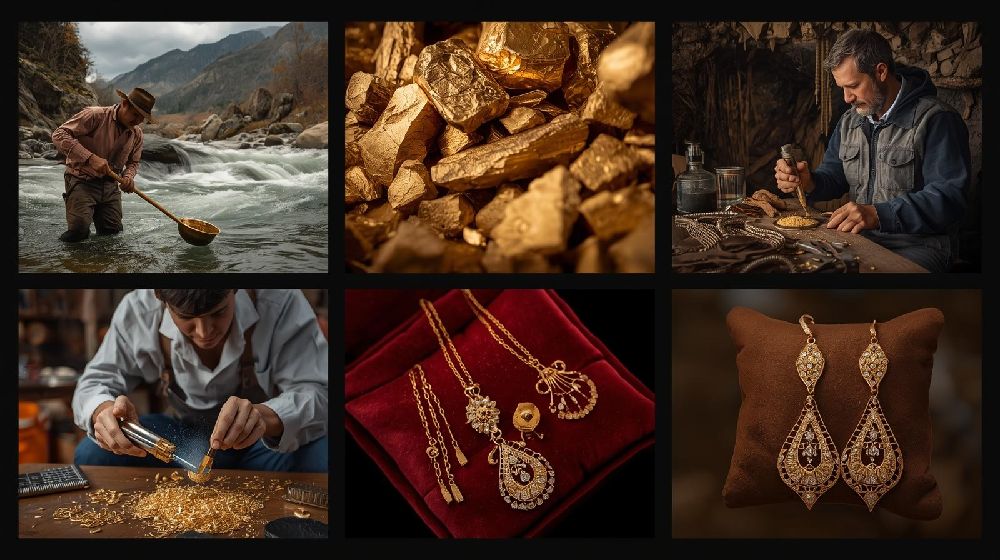
Gold has fascinated humans for millennia, prized for its beauty, rarity, and enduring value. But the gleaming rings, bangles, and necklaces we wear are the result of a complex journey from the earth’s crust to the jeweler’s workshop. Understanding this journey highlights both the artistry and science behind every piece of gold jewelry.
Step 1: Mining Gold
The journey begins in gold-rich regions around the world. Gold is found in ores and riverbeds, often mixed with other metals and minerals. Modern mining involves:
-
Open-pit mining: Large-scale extraction from surface deposits
-
Underground mining: Accessing deeper gold veins
-
Placer mining: Collecting gold particles from riverbeds
After extraction, the raw gold is separated from rock and impurities using techniques such as gravity separation, flotation, and chemical processing.
Step 2: Refining and Purification
Raw gold contains other metals like silver, copper, and trace minerals. To achieve the purity required for jewelry, gold undergoes refining, often using:
-
Miller process (chlorine gas for 99.5% purity)
-
Wohlwill process (electrolytic refining for up to 99.99% purity)
This ensures the gold is soft, malleable, and perfect for shaping into jewelry.
Step 3: Alloying for Strength and Color
Pure gold (24K) is too soft for everyday wear. To improve strength, durability, and color, jewelers create gold alloys:
-
22K gold: Mostly gold with a small amount of copper or silver
-
18K gold: 75% gold, 25% alloy
-
14K or 10K gold: Lower purity for extra durability
Alloying also allows for a variety of gold colors: yellow, rose, white, and green gold, depending on the metals used.
Step 4: Designing and Crafting Jewelry
Once refined and alloyed, gold enters the hands of skilled designers and artisans. Jewelry is shaped using:
-
Casting: Pouring molten gold into molds
-
CNC machining: Precision-cutting designs
-
Handcrafting: Hammering, engraving, or sculpting intricate patterns
This stage transforms gold from raw material into wearable art, whether it’s a sleek modern bangle or an ornate traditional necklace.
Step 5: Finishing and Detailing
The final steps make the jewelry shine and ready for wear:
-
Polishing: Smooths the surface and enhances reflectivity
-
Texturing: Adds patterns or matte finishes
-
Plating or Rhodium coating: Enhances color and prevents tarnish
-
Stone setting: Embedding diamonds, gems, or precious stones
Each piece undergoes quality checks to ensure durability, comfort, and aesthetic perfection.
Step 6: Ready for the Market
After finishing, gold jewelry is packaged and presented to consumers, completing its journey from mine to masterpiece. Today, responsible jewelers also emphasize ethical sourcing, sustainability, and traceability, ensuring the gold’s journey is as transparent as it is luxurious.
Conclusion
The journey of gold is a combination of natural wonder, scientific precision, and human artistry. From its cosmic origin deep within the Earth to the delicate rings and bangles we wear, gold carries a story of rarity, craftsmanship, and timeless value. Every piece of gold jewelry is not just an accessory—it’s the result of millions of years of natural formation and centuries of human ingenuity.