
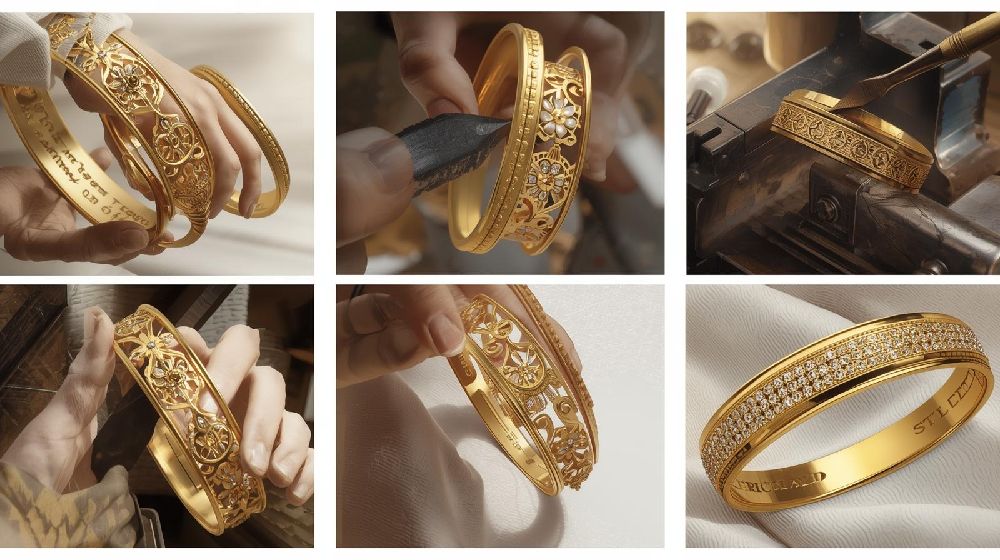
A Complete Guide to Traditional, Modern & Technology-Driven Bangle Making
Gold bangles are one of the most iconic pieces of jewelry across cultures. From classic handcrafted kada designs to modern CNC-finished bangles, each style carries its own identity — and each requires a different manufacturing technique.
Whether you are a jewelry lover, a retailer, or part of the gold manufacturing industry, this guide explains the most popular types of gold bangles and how every style comes to life inside the workshop.
✨ Why Understanding Bangle Types Matters
Every bangle differs in:
-
Production time
-
Manufacturing technique
-
Strength & durability
-
Design complexity
-
Weight & gold wastage
Knowing these helps customers choose better and helps jewelers explain craftsmanship more effectively.
1. Solid Bangles — The Classic & Timeless Style
What Are Solid Bangles?
Solid gold bangles are made from a continuous circle of gold with no hollow space inside. They are durable, long-lasting, and traditional.
How They Are Manufactured
-
Gold is melted and cast into rods.
-
Rods are rolled to the required thickness.
-
Craftsmen bend the rod into a circular shape.
-
The ends are welded using torch or laser welding.
-
Final shaping, sizing, and polishing complete the piece.
Best For: Bridal sets, premium collections, traditional wear.
2. Hollow Bangles — Lightweight & Budget-Friendly
What Are Hollow Bangles?
Hollow bangles look solid but are empty inside. They offer bold designs with much lighter weight.
Manufacturing Process
-
Thin gold sheets are rolled into tubes.
-
Tubes are shaped into bangles using forming machines.
-
Precision welding seals the tube perfectly.
-
CNC or laser machines may add external patterns.
-
Final polishing gives a shiny, finished look.
Best For: Daily wear, fashion collections, gifting.
3. Casting Bangles — Bold, Detailed & Artistic
What Are Casting Bangles?
These bangles are made through the casting process, allowing complex shapes, textures, and artistic details.
How They Are Manufactured
-
Designers create a 3D CAD model.
-
The model is printed in wax.
-
Wax tree is created for mass production.
-
Investment casting forms a mold.
-
Molten gold is poured inside.
-
After cooling, the mold is broken, and the bangle emerges.
-
Filing, soldering, finishing, and polishing are done manually.
Best For: Designer bangles, textured patterns, stone-studded styles.
4. CNC Bangles — Precision Cut & Modern Luxury
What Are CNC Bangles?
CNC (Computer Numerical Control) bangles feature sharp, geometric, and diamond-cut-like patterns created by machines.
Manufacturing Method
-
Start with a solid or hollow tube.
-
CNC machine cuts micro-designs with extreme precision.
-
Multi-axis movement creates 3D and 4D patterns.
-
Laser finishing enhances shine and sharp edges.
Best For: Modern, stylish bangles with brilliant sparkling effects.
5. Laser-Welded Bangles — Seamless & Highly Durable
What Makes These Special?
Laser welding creates invisible joints, increasing strength and providing a clean, flawless finish.
Manufacturing Steps
-
Components are made separately (body, edges, joints).
-
High-precision laser welding joins them.
-
This avoids excess heat and prevents damage.
-
Final polishing ensures no visible seam or line.
Best For: High-quality premium bangles, especially openable bangles.
6. Openable Bangles — Practical & Stylish
What Are They?
These bangles come with a hinge and lock system, making them easy to wear and remove.
How They Are Manufactured
-
Bangle is crafted in two halves (casting or CNC).
-
Hinges and locks are made separately using micro-components.
-
Laser welding is used to assemble fine parts.
-
Final checking ensures lock strength and smooth movement.
Best For: Daily wear bangles, elderly customers, bridal pieces.
7. Kada Bangles — Thick, Bold & Cultural
What Is a Kada?
A kada is a thicker, often wider bangle, sometimes for men, designed with heavy patterns or plain finishes.
Manufacturing Technique
-
Created using forging, rolling, or casting.
-
Heavy polishing tools give a smooth or hammered finish.
-
Sometimes laser engraving or CNC detailing is added.
Best For: Traditional wear, men’s jewelry, temple-style designs.
8. Flexible Bangles — Smooth, Comfortable & Trendy
What Are Flexible Bangles?
Made with multiple small joints or wires, flexible bangles easily adjust to wrist movement.
Manufacturing Process
-
Thin wires or micro-links are crafted individually.
-
Each link is laser-welded or joined with precision.
-
Gold tubes and springs may be used for flexibility.
-
Polishing and cleaning complete the piece.
Best For: Modern fashion jewelry, lightweight collections.
9. Textured Bangles — Matte, Hammered, Gloss & More
What Makes Them Unique?
Textures enhance personality using surface design.
How They Are Made
-
Matte by sanding or blasting
-
Gloss by high-speed polishing
-
Hammered by hand tools
-
CNC by machine engraving
Best For: Stylish women, gifting, designer collections.
✨ Final Thoughts: Choosing the Right Bangle Style
| Bangle Type | Key Features | Manufacturing Method |
|---|---|---|
| Solid | Strong & timeless | Rolling + welding |
| Hollow | Lightweight | Tube forming |
| Casting | Detailed designs | Investment casting |
| CNC | Precision patterns | Machine engraving |
| Laser-Welded | Seamless joints | Laser technology |
| Openable | Easy-to-wear | Hinges + locks |
| Kada | Bold & heavy | Forging/casting |
| Flexible | Comfortable | Links + wiring |
| Textured | Surface designs | Manual/CNC finishing |
Each type reflects a different blend of craftsmanship and technology. Understanding these makes it easier to choose the right bangle — whether for retail, manufacturing, or personal style.